2D Classification
Source: examples/classification_2d/main.py
Overview
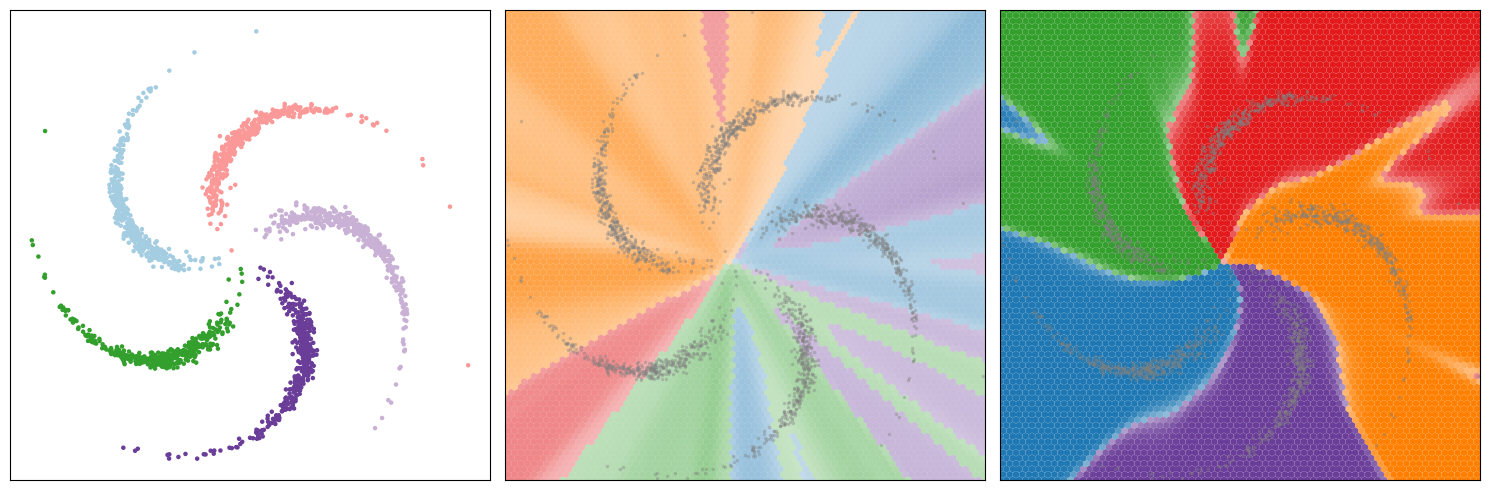
A small classifier learns to separate a 2D pinwheel dataset — several interleaved spiral arms, one per class. The example demonstrates multi-class cross-entropy loss, accuracy estimation, and decision-boundary visualisation.
Running
python -m examples.classification_2d.main          # defaults
python -m examples.classification_2d.main --help   # see all options
Selected options:
--num-steps— training steps (default 3 000)--num-classes— number of pinwheel arms / classes (default 5)--hidden-dim— width of each hidden layer (default 64)--plot— generate a decision-boundary figure at the end
Code walkthrough
Dataset
The pinwheel dataset produces 2D points arranged in interleaved spiral arms:
dataset = PinwheelDataset(num_classes=5, samples_per_class=512, ...)
# dataset.data: Array (N, 2), dataset.targets: Array (N,) int
Model
A three-layer network defined as a Module subclass:
class Classifier(nn.Module):
    def __init__(self, input_dim, output_dim, hidden_dim):
        super().__init__()
        self.linear1 = nn.Linear(input_dim, hidden_dim)
        self.linear2 = nn.Linear(hidden_dim, hidden_dim)
        self.linear3 = nn.Linear(hidden_dim, output_dim)

    def forward(self, x):
        x = npg.tanh(self.linear1(x))
        x = npg.tanh(self.linear2(x))
        return self.linear3(x)
Loss and accuracy
Cross-entropy on raw logits:
loss = nn.cross_entropy_loss(net(x), y)
Accuracy from argmax predictions:
correct = npg.sum(npg.argmax(net(x), axis=1) == y).item()
Training loop
optimizer = npg.optim.AdamW(net.parameters())
for step in range(num_steps):
    x, y = next(iter(train_dataloader))
    optimizer.zero_grad()
    loss = nn.cross_entropy_loss(net(x), y)
    loss.backward()
    optimizer.step()